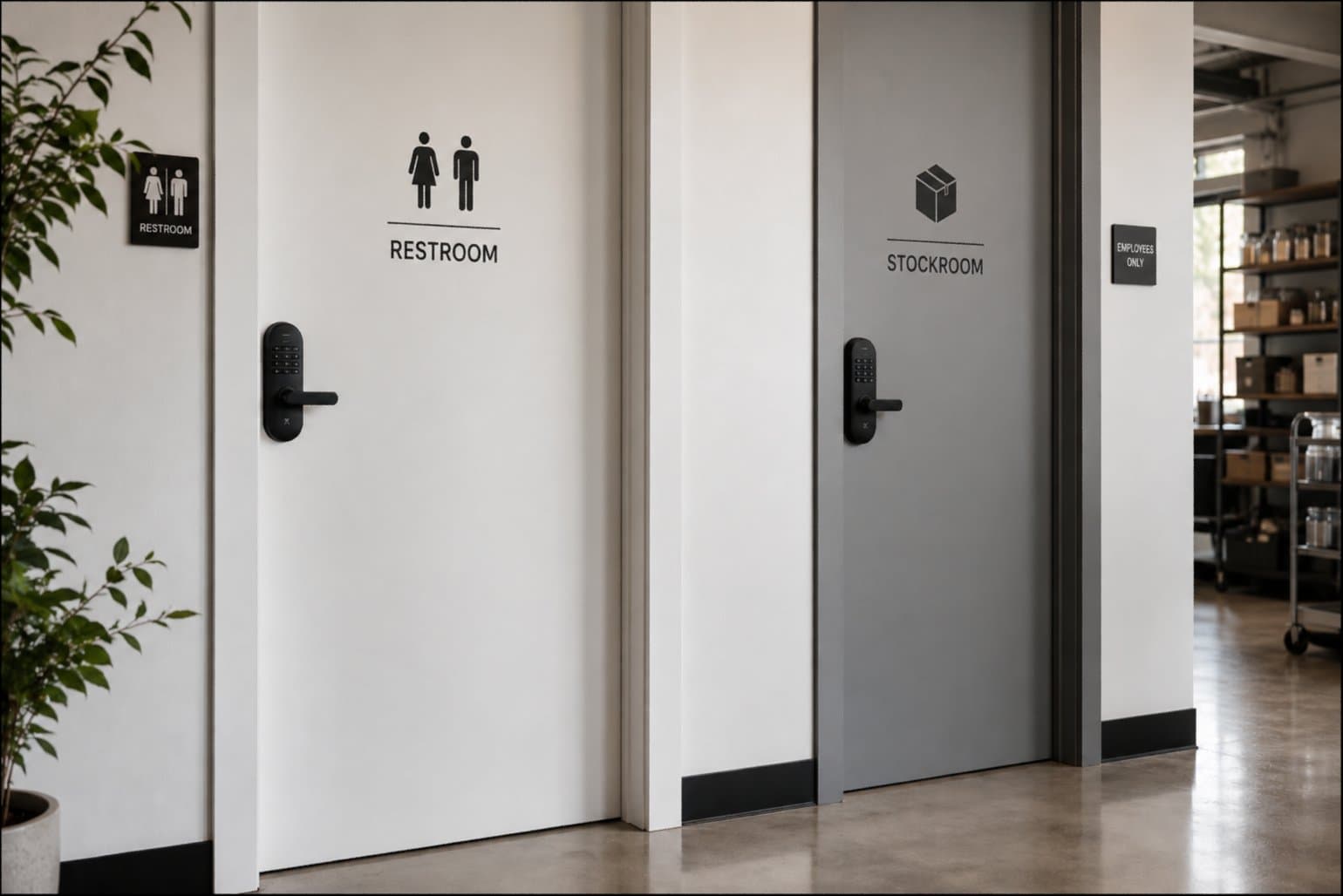
Yedi knows every time the restroom door opens, how long someone was in there, and when it's actually time to send someone in.
Stop cleaning on a schedule. Stop pulling associates off the floor for nothing. Stop guessing why you got a 1-star review.
Every bathroom has the same sheet on the wall. Initials in a column. Times in another. Everyone in retail knows it gets filled in at the end of the shift, in one sitting, sometimes by one person.
Customers know too.
The customers who don't come back after a bad bathroom experience aren't reading the clipboard. They're looking at the floor, the seat, the trash bin, the sink. And then they're quietly removing your store from the rotation. You don't hear about it. You just stop seeing them.
of US adults say they won't return to a restaurant where the bathroom was dirty.
Bradley Restroom Hygiene SurveyA scheduled bathroom check isn't free. It's an associate walking the floor, putting down what they're doing, going to the back, doing the check, coming back, picking up where they left off. Multiply that by every shift, every day, every location.
Most of those checks find a bathroom that didn't need checking. The clipboard gets initialed, the associate goes back to the floor, the cycle repeats.
Yedi reverses the logic. The lock counts entries. The lock measures dwell time. When the bathroom has had real traffic — not when an arbitrary 30-minute timer went off — the app tells one person to check it. The rest of the time, your team is on the floor where you actually need them.
And when they do check it, Yedi captures it — a timestamped check-in from whoever did the work, paired with a scored photo of the result. You get proof it happened, not an initialed clipboard. More on that scoring below.
Every operator who runs a public restroom has had the conversation. The toilet paper budget is up. The soap budget is up. The hand-towel budget is up. The number of customers using the restroom hasn't changed.
Yedi shows you the door-open rate against the consumption rate. When the two don't match, the outliers are obvious — a specific store, a specific shift, a specific window of time. You don't have to accuse anyone of anything. The data is just there.
Supply-cost reduction reported by Yedi customers on consumables they used to lose without explanation.
Yedi customer data, 2025There are two ways to run a Yedi restroom: Yedi Pro — the smart lock — on the door, or Yedi — the sign — beside it. This is Yedi Pro — the data-rich option, and the one most of this page is about.
Customers tap a code or scan a card to unlock. Staff use a separate credential. The code rotates on whatever schedule you choose — nightly, weekly, after a specific number of uses — so the one that ended up on a Reddit thread last month doesn't keep letting people in forever.
The dashboard is where the actual value lives. Every entry. Every exit. Every duration. Per store, per shift, per hour. Filter, alert, export, integrate with the systems you already run.
The hardware retrofits a standard commercial restroom door in under 30 minutes. No wires. No locksmith. No new door.
In pilotCounting door-opens tells you the restroom was used. It does not tell you whether it is actually clean. CleanScore closes that gap. After a cleaning event, staff photograph the restroom. A vision model reads the photo and assigns a score.
Over days and weeks, that score becomes a trend line for every location. A store drifting downward shows up as a falling line on a chart — weeks before it shows up as a one-star review. You see the slip while it is still cheap to fix, and you see exactly which store and which shift to talk to.
CleanScore is piloting now with select retail partners. We label it as a pilot because that is what it is — live and learning, not yet universal. As it proves out, it becomes a standard part of the restroom configuration.
Not every restroom needs the full hardware. Yedi — the sign — is the hardware-free way to run access: a printed QR code on the door. Customers scan, pay, and get an entry code on the spot — no lock to install, no wiring, nothing to retrofit.
You set the code and the price; Yedi handles the payment and hands the customer their code the moment it clears. It's the fastest path to turning a free public restroom into a paid one — particularly for transit-adjacent retail, gas-station convenience, and high-traffic urban storefronts where the restroom has become a public utility.
You give up the deep usage and dwell data Yedi Pro collects, but you gain a deployment you can stand up in minutes. Many operators start with Yedi and add Yedi Pro later — same platform, same dashboard, whenever you're ready.
We'll show you what the data from your own stores would tell you about how often the restroom actually needs attention, what supplies are going where, and what your associates are doing with the time they get back.